
Introduction
Home and Community-Based Services (HCBS)1 help people with disabilities of all ages live in their own homes and communities, instead of being forced into nursing homes, state hospitals, or group homes. These services are paid for by the state through Medicaid. But in South Carolina, many people have a hard time getting them because of long waitlists, not enough workers, and too little funding.
Medicaid is the biggest source of funding for long-term care in the U.S, covering most HCBS services.2 Unfortunately, South Carolina’s Medicaid program for these services is one of the most limited and underfunded in the country. In a 2023 national report from AARP, South Carolina ranked 49th out of all the states, scoring especially low in areas like affordability, access, and helping people stay in their communities.3 As of 2024, South Carolina had the third-longest waitlist for HCBS, with nearly 34,000 people waiting–only Texas and Florida had longer lists.4
In South Carolina, two state agencies manage Home and Community-Based Services (HCBS) waivers:
- The South Carolina Department of Health and Human Services (SCDHHS
- The South Carolina Department of Disabilities and Special Needs (SCDDSN)5
SCDHHS is in charge of several programs:
- Community Choices Waiver (22,734 people were enrolled in 2023)
- HIV/AIDS Waiver (468 people)
- Mechanical Ventilator Waiver (46 people)
- Palmetto Coordinated System of Care for Children (77 children)
These programs don’t have official waitlists because they don’t limit how many people can enroll. However, they do keep a “pending” or “interest” list of people who are waiting to be approved. Different states call these lists by different names, so it can be hard to know exactly how many people are waiting.
SCDDSN runs waivers for people with disabilities, including:
- Intellectual Disability/Related Disabilities (ID/RD) Waiver
- Community Supports Waiver
- Head and Spinal Cord Injury Waiver
These waivers do have waitlists.6 The ID/RD Waiver has the longest waitlist in the state, with:
- 29,862 people waiting in 2023.
- That number grew to 33,559 in 2024, showing the problem is getting worse.7
This report looks at South Carolina’s Home and Community-Based Services (HCBS) system, focusing on the problems caused by long waitlists, not enough care workers, and unequal access to services in different parts of the state. It was created by New Disabled South and the National Domestic Workers Alliance (NDWA). The report uses both numbers and real-life stories from disabled people and care workers to show how the system is broken. It calls for urgent changes in policy and more funding so that everyone can get the care they need.
“The experience of being on the waitlist is traumatizing—like a dark cloud hanging over me. It’s affecting not just my mental and emotional health but also my physical well-being.”

UNEQUAL ACCESS ACROSS REGIONS AND RACES
There is a clear need to fix South Carolina’s HCBS system. Reports from nearby states show big racial differences in who gets services. For example, in Georgia, a report found that Black people were added to waitlists at a much higher rate than white people–by about 28%.8 Even though South Carolina hasn’t released similar data, a 2024 national report shows that over 540,000 people across the Southern U.S. are waiting for HCBS services. This suggests that many people, especially in marginalized communities, face serious barriers to getting the help they need. Older adults of color are especially at risk, often missing out on services because they are just above the income limit for Medicaid but still can’t afford care on their own.9
If changes aren’t made soon, these problems will only get worse, and the most vulnerable people will be left without the support they need to live safely and with dignity in their own homes.
“My daily life is limited because of my disability, and without HCBS services, I can’t do the things I enjoy, like my hobbies. I’ve become more introverted, staying home, feeling angry and bitter. I used to love going outside, traveling, and socializing, but now I’m stuck indoors.”

DIRECT CARE WORKER SHORTAGE
To reduce South Carolina’s long waitlist for Home and Community-Based Services (HCBS), the state needs a strong and reliable care workforce. Personal care attendants and home health aides help older adults and disabled people with everyday tasks like eating, dressing, bathing, and keeping their homes clean. Their work makes it possible for many people to live in their own homes instead of being sent to nursing homes or other institutions.
But there aren’t enough care workers to meet the need. Because of this shortage, thousands of people are stuck waiting for services they can’t yet get. Russell Morrison from South Carolina’s Department of Health and Human Services said this lack of workers is one of the biggest reasons the waitlist is so long and why access to care is unequal across the state.

THE WORKFORCE CRISIS
A 2024 report from the Kaiser Family Foundation (KFF) showed that every state is struggling with a shortage of home care workers–South Carolina especially. By 2032, the state will need to fill 66,500 new jobs in this field.10 The problem? Low pay.
In 2022, South Carolina Medicaid only paid care agencies $14 per hour for services. That amount has increased to $25 per hour,11 but it’s unclear if workers are actually being paid more. Agencies are only required to pay workers the federal minimum wage of $7.25/hr and most home health aides in South Carolina only earn about $13.62 per hour,12 which makes it hard to keep workers in these jobs.
At the same time, the need for care is growing. By 2030, there will be nearly 1.5 million people over age 60 in South Carolina. In 2020, there were already over 295,000 seniors with at least one disability, and that number is expected to rise.13
“I have to work 2 jobs and when I don’t work, I don’t get paid. It has been a struggle for me to provide for my family. I am doing something that I love to do when it comes to helping others and making sure they are able to stay at home and not go into a facility. I would like to let my South Carolina legislators know that I love the work that I do, but as a caregiver I can’t survive off one part-time job with no paid time off and no benefits. I would also like them to know that the cost of living goes up every year and my pay doesn’t. I want to continue working with the family that I’m working with and in order to do so I need a raise and a paid time off. The hours are also too low and I would like this job to be one full time job.”
Unless South Carolina invests in better pay, benefits, and recruitment for care workers, the system will continue to be understaffed. That means more disabled people and families will go without the help they desperately need.
The best way to attract and keep home care workers is to pay them a fair, livable wage. Right now, 27 states have laws that make sure when Medicaid increases funding, that extra money goes directly to worker’s pay.14 These are called wage pass-through laws.
In 2022, the South Carolina Institute of Medicine & Public Health15 released a report about how to improve hiring and keep more care workers. Their #1 recommendation was for South Carolina to pass a law like this, making sure Medicaid funding actually leads to better pay for workers.
Also, the federal government has stepped in. The Centers for Medicare & Medicaid Services (CMS) just passed a new rule that says that states must make sure that at least 80% of Medicaid payments for home care,16 go toward worker pay and benefits.17
“My industry is a skilled field and everyone can not be a caregiver. I have to hold the knowledge of each one of my clients in my mind daily in order to make sure I am providing the best care possible. I am worth more than $7.25. My labor. My time. My day starts well before I clock in at my first client of the day house. I have to use all that I have learned about each client to make sure they have what they need because believe it or not their lives depend on me getting it right. I deserve to have a piece of mind at my work place and fair compensation.”
If South Carolina followed this rule, care workers could make around $20 per hour, including benefits–likely with a base of about $18/hr. This would make the job much more appealing and help solve the worker shortage.
But South Carolina hasn’t adopted this type of policy yet. Because of that, it remains even harder for people in the state to get the care they need.
“I bathe, feed, support with incontinence, meal prep and cooking, light cleaning and provide emotional support. Despite the work I do to improve the quality of life for the people I serve, I don’t receive any medical benefits, sick time and have little economic security. I don’t get paid for mileage and I drive 20 miles twice a week for work. I recently went from making $700 to $300 per week because the authorized hours for my client changed. We don’t get paid very much, almost nothing for the commitment this work requires.”
PROBLEMS WITH TRANSPARENCY AND DATA IN SOUTH CAROLINA’S HCBS SYSTEM
To understand who is on South Carolina’s waitlist for Home and Community-Based Services (HCBS), New Disabled South asked the state’s Department of Disabilities and Special Needs (SCDDSN) for information using a public records request (FOIA). SCDDSN gave some general numbers but refused to share data on race and ethnicity, even though they collect that information. Without this, it’s very hard to tell whether racial groups are being treated fairly in the system.
They also sent a similar request to the South Carolina Department of Health and Human Services (SCDHHS) to learn more about how long it takes people to go from applying to actually receiving services. The agency responded vaguely, saying that they couldn’t give a clear answer because:
- Some people never finish their applications
- Some don’t qualify for financial reasons
- Others don’t meet the health criteria needed for services.
This response shows a serious lack of transparency, making it hard to know how long people wait or why they might be stuck in the system.
For example, in August 2024, SCDDSN said 20,296 people were on the HCBS waitlist.
But a 2024 national report (from KFF) said there were 33,99218 people waiting in South Carolina with 33,559 of those waiting specifically for the Intellectual and Developmental Disabilities (IDD) Waiver. In 2023, KFF had reported 41,078 people but that number included people on the “interest list” from a different department (SCDHHS). The 2024 report didn’t count the interest list, which partly explains the difference. These mixed-up numbers show the need for clear, consistent and public data so the real size of the problem can be understood-and fixed.
WHY WAITLIST NUMBERS DON’T SHOW THE WHOLE PICTURE
Waitlists can give us a rough idea of how many people need services-but they don’t show the full picture.19
For example:
- Some states don’t offer certain services, so people who need them aren’t even on a waitlist.
- In some places, people are put on a waitlist before they’re screened to see if they are eligible, so it’s unclear how many really qualify.
How long a state’s waitlist is depends on many factors, including:
- Who the state decides to serve
- What services it offers
- How much money it puts into the system
- And how many workers are available to provide care20
So, waitlist numbers alone don’t fully measure how many people actually need help.
Another thing that affects how available HCBS services are is how well states are following federal rules. In 2014, the government created the HCBS Settings Rule, which says that services paid for by Medicaid must help people live and be included in their communities-not isolated in institutions like nursing homes.21
But many states, including South Carolina, have been slow to fully follow these rules. These delays affect how money is spent, who gets services first, and who qualifies-all of which can change the size of waitlists and how well we understand who still needs help.
Some states don’t have official waitlists at all. Instead, they keep “registries” or “interest lists,” which makes it even harder to know how many people are waiting for services.22 The lack of a standard way to track this across the country–plus delays in expanding services–makes it difficult to understand how big the problem really is.
Even with these problems, there’s no better way right now to measure how many people need help. But as the federal government continues to push states to follow the rules and improve their tracking, the data will hopefully get more accurate–and give a clearer view of where care is missing.
AGE AND GEOGRAPHIC TRENDS IN THE HCBS WAITLIST

This bar graph called “Age Distribution of People Currently on the SC HCBS Waitlist,” shows how many people in different age groups are waiting for services in South Carolina.
The age groups are:
-
0-17
-
18-29
-
30-39
-
40-49
-
50-59
-
60 and older
The graph makes it clear that most people on the waitlist are children and young adults. Kids under 18 make up the largest group followed by people aged 18–29. After that, the numbers drop off as the age groups get older.
This shows there is a huge need for services for young people, especially children. It also shows why it’s so important to invest in early help and better support options for families and young adults in the community.

This bar graph called “People Added to the HCBS Waitlist by Age Range and Year,” shows how many people in different age groups were added to South Carolina’s HCBS waitlist each year from 2016 to 2024.
The age groups are:
-
0-17
-
18-29
-
30-39
-
40-49
-
50-59
-
60 and older
Each year is shown as one bar, with different colors representing each age group. The taller the bar, the more people were added that year. Here’s how many people were added to the waitlist each year:
2016: 277
2019: 2,047
2022: 3,246
2017: 1,871
2020: 2,021
2023: 3,088
2018: 1,699
2021: 3,137
2024: 1,695
The number of people added each year changed over time, but there was a big jump after the COVID-19 pandemic, especially in 2021 and 2022, when over 3,000 people were added each year. One big change was the increase in older adults (age 60+) being added to the waitlist, showing that more seniors now need services. Meanwhile, the number of children and young adults (ages 0-29) added to the list stayed steady, showing a consistent, ongoing need for services for younger people.
GEOGRAPHIC DISTRIBUTION AND REGIONAL NEEDS
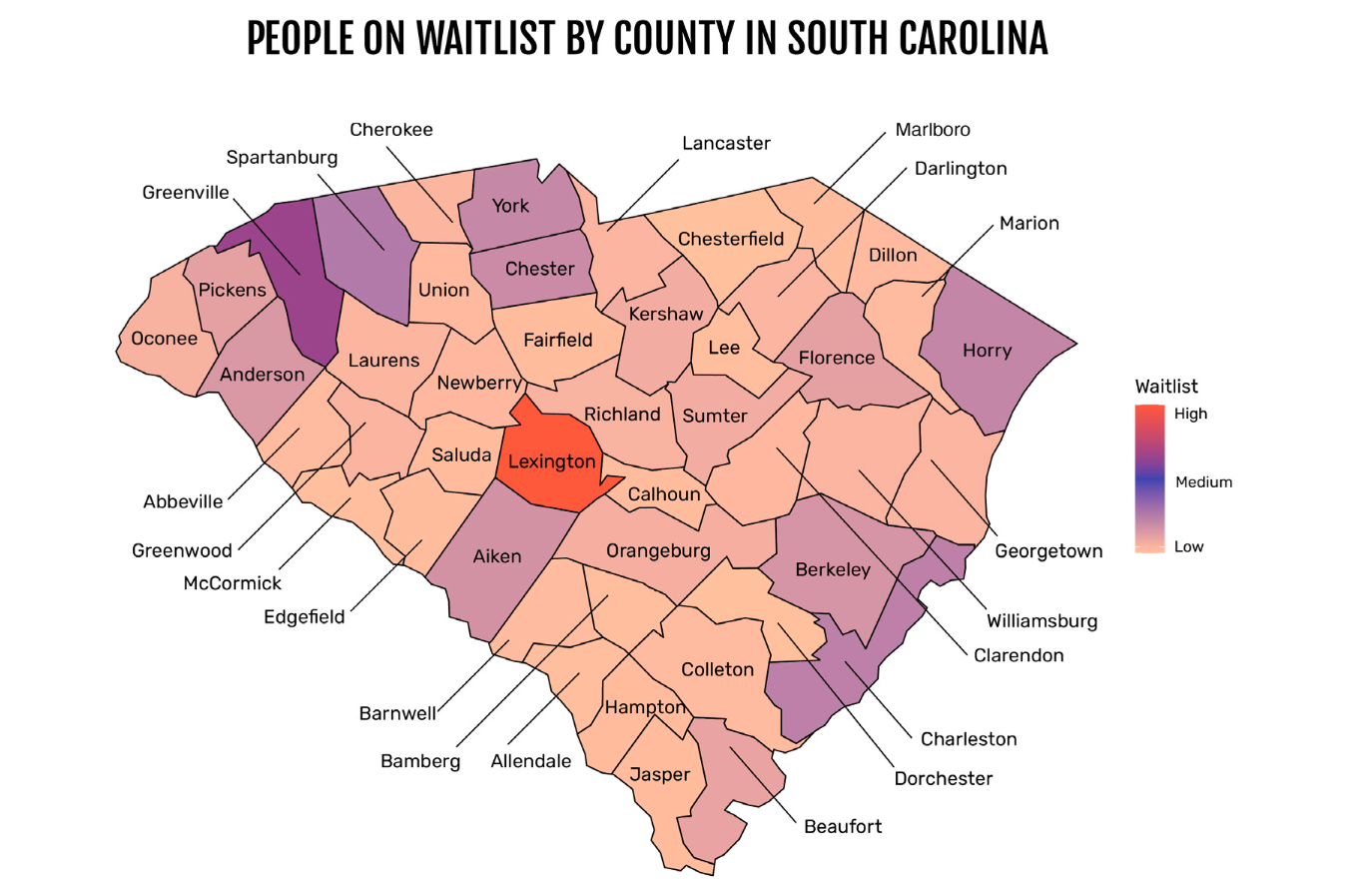
This color-coded map of South Carolina shows how many people are on the Home and Community-Based Services (HCBS) waitlist in each county. Counties are shaded in different colors to show low, medium, and high numbers of people waiting. Lexington County is highlighted in orange because it has the highest number of people waiting. This type of map shows where service shortages are worse and where more resources are needed.

LISTENING TO PEOPLE ON THE HCBS WAITLIST
To understand how the HCBS waitlist affects people, researchers combined data with in-depth interviews of 11 people currently waiting for services. The interviews provided personal stories that reveal everyday challenges and systemic problems in HCBS. Here are the key points:
1. MENTAL HEALTH IMPACTS
Every interviewee mentioned that long wait times and a confusing system harmed their mental health. Many described feelings of isolation, anxiety, and frustration because of the uncertainty about when they would get help. One person described the experience as “traumatizing”, saying it affected both their mental and physical health.
2. STRAIN ON INFORMAL CAREGIVERS
Almost everyone talked about how family members and friends had to step in to provide care because formal services were delayed or unavailable. This extra burden causes stress, financial hardship, and can even harm relationships. Many felt like they were a burden to their loved ones.
“It’s a challenge every day. I’ve lost hope that things will change. My sister tries her best to help, but it affects her life too. She has to take time off work to look after me, and I feel like a burden. It also impacts our relationship because I lash out sometimes, which I don’t want to do, but it’s hard when I feel this way.”
3. FINANCIAL STRAIN
About half of the people interviewed said that paying for care out-of-pocket or relying on unpaid caregivers added to their stress. Many recommended that the state provide temporary services and better communication about waitlist status to ease the burden.
4. RECOMMENDATIONS FOR CHANGE
Around 70% of the participants offered ideas for improvement. They stressed the need for immediate support options, clarified updates on where they stand on the waitlist, and overall systemic changes to fix long-standing problems in HCBS access.
“My family feels burdened trying to care for me. They won’t say it, but I know
resentment can build up. It’s just a lot, especially with my head injury.”
CHALLENGES FACED BY HCBS WORKFORCE
CARE WORKERS FINANCIAL AND WORKPLACE BARRIERS
Interviews with care workers, carried out with the National Domestic Workers Alliance, revealed major challenges in the Home and Community-Based Services (HCBS) system. These conversations shed light on the everyday struggles that care workers face, which affects both the quality of care and the stability of the workforce.
For example, Harriet Tucker–a 65 year old Black direct care worker from Columbia, South Carolina–shared that her starting wage was about $11 per hour, and even now she only earns $14 per hour. To work a full 50-hour week, she must take on four clients. Harriet explained that without working, she doesn’t get paid. She also noted that there are no paid holidays, no reimbursements for travel expenses, and no paid sick leave or medical leave. After having surgery on her arms in 2020, she was out of work for four months and struggled financially, surviving only because of her Social Security payments. Harriet stressed that care workers need benefits like paid sick leave and higher wages to make caregiving sustainable.
Another care worker–a 44-year-old Black woman from Richland County–discussed how travel costs can be overwhelming. She said that if a client lived too far away, she would avoid taking them on because the cost of traveling back and forth could put her family into debt. There were no mileage stipends or reimbursements to help cover these expenses, which made it difficult to accept clients who were far from home.
These financial difficulties, along with the lack of essential benefits such as paid sick leave and holiday pay, lead to high turnover rates and burnout among care workers. Despite these hardships, many care workers continue in their roles because of a deep commitment to helping others. They often work with clients who have complex needs, underscoring just how critical their work is.
“My responsibilities as a Personal Care Aide are extensive, along with assistance with activities of daily living, such as bathing, toileting, grooming and feeding, I do light cleaning, run errands, transport clients to doctor’s visits and remind clients to take medications. My work is essential to proper medical care, as I make sure that their skin isn’t breaking down and getting tears and constantly check for infections. I keep a record of their daily activities, documenting changes in behavior or in their body. We get paid minimum wage, but the work is not minimum. Your life and theirs revolve around each other. When you get to their homes you get no breaks, sometimes you will stay on a 8 hour shift non stop. All of the duties for the job cannot be done in a full day and some of the duties can run over. Clients are given a certain number of hours and you cannot do all the work that is required.”
POLICY RECOMMENDATIONS FROM CARE WORKERS
Care workers recommend several key changes to improve their working conditions:
-
Increase wages
-
Provide mileage reimbursements
-
Offer comprehensive benefits, including paid sick leave and holiday pay
They argue that better pay and benefits are essential not only for attracting and keeping care workers but also for ensuring that disabled people receive high-quality, reliable support.
SURVEY FINDINGS: LINKING EXPERIENCES TO SYSTEMIC ISSUES
An online survey conducted between November and December 2024 added more insights by collecting feedback from a broader group of HCBS waitlist participants and their caregivers. The survey findings reinforced that long wait times are a major problem–more than half of respondents reported waiting over five years for services. These delays are a clear sign of severe underfunding in South Carolina’s HCBS system, which mirrors national trends, but is particularly extreme in this state. The prolonged wait times have serious consequences, leading to worsening physical health, emotional distress, and financial strain for disabled individuals and their families.
Overall, these findings highlight the urgent need for systemic reform.
Improving pay, benefits, and support for care workers is crucial to reduce workforce shortages and ensure that everyone in need can receive timely, high-quality care.
EQUITY CONCERNS IN THE WAITLIST PROCESS
Survey responses show that many people feel the HCBS waitlist system in South Carolina is unfair. About 30% of respondents say they’ve been treated differently because of their race, where they live, or their income. For example, people in rural areas face extra challenges like few service providers and long travel distances.
Many respondents are frustrated by the lack of clear communication and updates about their waitlist status. They suggested improvements like a user-friendly online tracking system, better direct communication, and temporary support for those waiting a long time.
Most of the people who answered the survey are disabled or chronically ill, and many reported waiting more than five years for services. This long wait is due to chronic underfunding, making South Carolina’s HCBS waitlist one of the longest in the nation.
KEY POLICY RECOMMENDATIONS INCLUDE:
• Increase Funding and Transparency:
-
Provide clear, public data (including race and ethnicity) about waitlists.
-
Expand the number of available waiver slots, since the current plan only adds 1,000 slots, which is far too few for the nearly 34,000 people waiting.
• Empower Self-Directed Care:
-
Give people who use HCBS more control over how their Medicaid funds are spent so they can meet their own needs.
• Adopt Wage Pass Through Policies:
-
Require that at least 80% of Medicaid payments for home care services go directly to paying care workers at a minimum of $18 per hour, to improve wages, reduce turnover, and build a stronger workforce.
• Improve Worker Benefits and Support:
-
Offer travel reimbursement for workers serving remote areas.
-
Provide benefits like paid sick leave and overtime pay, and offer training incentives to attract new workers.
• Address Racial and Economic Disparities:
-
Conduct state-wide audits to uncover and address racial inequities.
-
Carry out targeted outreach to Black and Latinx communities, who are hit hardest by service gaps.
• Streamline the Eligibility and Waitlist Process:
-
Simplify the screening process to prevent long delays.
-
Create a real-time online tracking system so people can see their and better plan their next steps.
OVERALL MESSAGE:
South Carolina’s HCBS system is already struggling. Federal funding cuts will add more problems for the HCBS system. Funding is money used to make a program work. A cut means the money is taken away from a program. On July 4 2025, President Trump signed H.R. 1, An Act to Provide for Reconciliation Pursuant to Title II of H. Con. Res. 14. The resolution is also known as the One Big Beautiful Bill Act (2025). This bill will get rid of about $911 billion24 in federal Medicaid spending over a decade.
Because of the Medicaid cuts, states will:
-
Lower the amount of money health care providers are paid
-
Limit optional Medicaid services they pay for
-
Decrease enrollment
-
Enrollment is how many people have access to Medicaid health insurance
Home-based care for seniors, children, and people with disabilities are some of the first services states will get rid of. These Medicaid cuts would be terrible for South Carolina and the whole country. Almost 70% of South Carolina’s Medicaid funding comes from the federal government. If that money is decreased, the state may have to raise taxes or get rid of other important services.
Over 33,000 people in South Carolina are already waiting for care. Without federal support, even more people will be stuck waiting.
Across the United States, these cuts could mean:
-
7.8 million people lose access to home care services
-
2.5 million care workers lose jobs or get paid less money to do their jobs
-
17 million disabled and older adults are put at risk of having poor health or dying
-
Families who already provide unpaid care would struggle more.
South Carolina ranks 49th in the nation for long-term care. Losing funding would make things worse. People of color and low-income families would be hurt the most by the cuts. The Medicaid cuts would undo years of progress in disability rights and fair access to care. These cuts must be stopped to protect the health, independence, and self-respect of millions of people.
ACKNOWLEDGMENTS
We couldn’t have completed this research without the support of our community, organizations, and stakeholders who shared their time, expertise, and personal experiences. We are especially grateful to the people on the HCBS waiver waitlist, as well as caregivers, and care workers who courageously told us their stories, and showed us why change is needed. We also deeply appreciate contributions of the following organizations that work to strengthen Home and Community-Based Services (HCBS) in South Carolina:
-
Disability Rights South Carolina
-
Hearts for Home Care South Carolina
-
American Association of Retired Persons (AARP)
-
South Carolina Department of Health and Human Services
-
University of South Carolina’s Center for Disability Resources
-
South Carolina Appleseed
-
South Carolina Institute of Medicine and Public Health
REFERENCES
AARP. (2023). South Carolina: 2023 LTSS state scorecard. LTSS Choices. https://ltsschoices.aarp.org/scorecard-report/2023/states/south-carolina#toc-explore-data
Centers for Medicare & Medicaid Services. (n.d.-a). Home & community-based services. Medicaid.gov. https://www.medicaid.gov/medicaid/home-community-based-services/index.html
Centers for Medicare & Medicaid Services. (n.d.-b). Long-term services & supports (LTSS). Medicaid.gov. https://www.medicaid.gov/medicaid/long-term-services-supports/index.html
Centers for Medicare & Medicaid Services. (2024, April 22). Biden-Harris administration takes historic action to increase access to quality care and support families. https://www.cms.gov/newsroom/press-releases/biden-harris-administration-takes-historic-action-increase-access-quality-care-and-support-families
Conner, A. M., Haire, E., Howell, K., & Sanderson, B. (2023). Opportunities for South Carolina to strengthen home and community-based services for people with disabilities. Disability Rights South Carolina & South Carolina Institute of Medicine and Public Health.
Institute for Health and Justice Equity. (n.d.). Wage pass-through report. https://ihje.org/our-work/reports/wage-pass-through/
KFF. (2023). Medicaid in South Carolina. https://files.kff.org/attachment/fact-sheet-medicaid-state-SC
KFF. (2024a). A look at waiting lists for Medicaid home and community-based services from 2016 to2024. https://www.kff.org/medicaid/issue-brief/a-look-at-waiting-lists-for-medicaid-home-and-community-based-services-from-2016-to-2024/
KFF. (2024b). Medicaid HCBS waiver waiting list enrollment by target population and whether states screen for eligibility. https://www.kff.org/medicaid/state-indicator/medicaid-hcbs-waiver-waiting-list-enrollment-by-target-population-and-whether-states-screen-for-eligibility/
KFF. (2024c). Payment rates for Medicaid home and community-based services: States’ responses to workforce challenges. https://www.kff.org/medicaid/issue-brief/payment-rates-for-medicaid-home-and-community-based-services-states-responses-to-workforce-challenges/
Milbank Memorial Fund. (2025, March). Aging at risk: The impact of Medicaid cuts on older adults. https://www.milbank.org/2025/03/aging-at-risk-the-impact-of-medicaid-cuts-on-older-adults/
New Disabled South. (2023). Waitlist disparities report. https://www.newdisabledsouth.org/reports/waitlist-disparities
NORC & The SCAN Foundation. (2024). Understanding historically marginalized & minoritized populations in the forgotten middle. NORC at the University of Chicago.
PHI. (2017, March 17). Shortsighted Medicaid cuts will endanger the lives and jobs of millions. https://www.phinational.org/shortsighted-medicaid-cuts-will-endanger-the-lives-and-jobs-of-millions/
PHI. (n.d.). Workforce data center: South Carolina employment projections. https://www.phinational.org/policy-research/workforce-data-center/#states=45&var=Employment+Projections
Rudowitz, R., & Hinton, E. (2023, May 8). Putting $880 billion in potential federal Medicaid cuts in context of state budgets and coverage. KFF. https://www.kff.org/medicaid/issue-brief/putting-880-billion-in-potential-federal-medicaid-cuts-in-context-of-state-budgets-and-coverage/
South Carolina Department of Disabilities and Special Needs. (n.d.). Medicaid home and community-based waiver services. https://ddsn.sc.gov/services/medicaid-home-and-community-based-waiver-Services
South Carolina Department on Aging. (2021). State plan on aging 2021–2025. https://aging.sc.gov/about-us/state-plan-aging
South Carolina Health & Safety Professional Association. (2025, January). South Carolina waiver waiting list fact sheet. https://schspa.com/wp-content/uploads/2025/01/SC-Waiver-Waiting-List-Fact-Sheet-Final.pdf
State of South Carolina, Office of the Governor. (2025). FY26 executive budget book. https://admin.sc.gov/budget/fy2025-26
USA Facts. (n.d.). Lexington County population and demographics. https://usafacts.org/data/topics/people-society/population-and-demographics/our-changing-population/state/south-carolina/coun
Citations
-
Centers for Medicare & Medicaid Services, Home & community-based services, Medicaid.gov, https://www.medicaid.gov/medicaid/home-community-based-services/index.html
-
Centers for Medicare & Medicaid Services, Long-term services & supports (LTSS), Medicaid.gov, https://www.medicaid.gov/medicaid/long-term-services-supports/index.html
-
AARP, South Carolina: 2023 LTSS State Scorecard, LTSS Choices, https://ltsschoices.aarp.org/scorecard-report/2023/states/south-carolina#toc-explore-data
-
KFF, Medicaid HCBS waiver waiting list enrollment by target population and whether states screen for eligibility, https://www.kff.org/medicaid/state-indicator/medicaid-hcbs-waiver-waiting-list-enrollment-by-target-population-and-whether-states-screen-for-eligibility/
-
Conner, A. M., Haire, E., Howell, K., & Sanderson, B. Opportunities for South Carolina to Strengthen Home and Community-Based Services for People with Disabilities.
-
Disability Rights South Carolina & South Carolina Institute of Medicine and Public Health, 2023. South Carolina Department of Disabilities and Special Needs, Medicaid home and community-based waiver services, https://ddsn.sc.gov/services/medicaid-home-and-community-based-waiver-services
-
KFF, Medicaid HCBS waiver waiting list enrollment by target population and whether states screen for eligibility, https://www.kff.org/medicaid/state-indicator/medicaid-hcbs-waiver-waiting-list-enrollment-by-target-population-and-whether-states-screen-for-eligibility/
-
New Disabled South, Waitlist Disparities Report, https://www.newdisabledsouth.org/reports/waitlist-disparities
-
NORC & The SCAN Foundation, Understanding Historically Marginalized & Minoritized Populations in the Forgotten Middle, NORC at the University of Chicago, 2024.
-
KFF, Payment Rates for Medicaid Home and Community-Based Services: States’ Responses to Workforce Challenges, https://www.kff.org/medicaid/issue-brief/payment-rates-for-medicaid-home-and-community-based-services-states-responses-to-work-force-challenges/
-
CMS, 1915(c) Waiver Applications, 2022-23.
-
PHI, Workforce Data Center: South Carolina Employment Projections, https://www.phinational.org/policy-research/workforce-data-center/#states=45&var=Employment+Projections
-
South Carolina Department on Aging, State Plan on Aging 2021-2025, 2021
-
Institute for Health and Justice Equity, Wage Pass-Through Report, https://ihje.org/our-work/reports/wage-pass-through/
-
The South Carolina Institute of Medicine & Public Health (IMPH) is an independent entity serving as an informed nonpartisan convener around the important health issues in our state, providing evidence based information to inform health policy decisions.
-
Home Health Services, Personal Care Services and Homemaker Services
-
Centers for Medicare & Medicaid Services. (2024). Biden-Harris administration takes historic action to increase access to quality care and support families. CMS. https://www.cms.gov/newsroom/press-releases/biden-harris-administration-takes-historic-action-increase-access-quality-care-and-support-families
-
Kaiser Family Foundation. (n.d.). Medicaid HCBS waiver waiting list enrollment by target population and whether states screen for eligibility Kaiser Family Foundation.
-
Musumeci, M., & Chidambaram, P. (2024, February 15). A look at waiting lists for Medicaid home and community-based services from 2016 to 2023. KFF. https://www.kff.org/medicaid/issue-brief/a-look-at-waiting-lists-for-medicaid-home-and-community-based-services-from-2016-to-2023
-
KFF, Payment Rates for Medicaid Home and Community-Based Services: States’ Responses to Workforce Challenges, https://www.kff.org/medicaid/issue-brief/payment-rates-for-medicaid-home-and-community-based-services-states-responses-to-work-force-challenges/
-
Administration for Community Living. (n.d.). Home and Community-Based Services (HCBS) settings rule. U.S. Department of Health and Human Services. https://acl.gov/programs/hcbs-settings-rule
-
Musumeci, M., Chidambaram, P., & Ochieng, N. (2024, January 22). A look at waiting lists for Medicaid Home and Community-Based Services from 2016 to 2024. KFF. https://www.kff.org/medicaid/issue-brief/a-look-at-waiting-lists-for-medicaid-home-and-community-based-services-from-2016-to-2024/
-
USA Facts. (n.d.). Lexington County population and demographics. USA Facts. https://usafacts.org/data/topics/people-society/population-and-demographics/our-changing-population/state/south-carolina/county/lexington-county/
-
Allocating CBO’s Estimates of Federal Medicaid Spending Reductions Across the States: Enacted Reconciliation Package | KFF https://www.kff.org/medicaid/allocating-cbos-estimates-of-federal-medicaid-spending-reductions-across-the-states-enacted-reconciliation-package/ Congressional Budget Office. (2021, February 10). Policy approaches to reduce what commercial insurers pay for hospital and physician services. https://www.cbo.gov/publication/61461